How Much Does Luxury Interior Design Cost and Why?
If you have ever tried to estimate the cost of luxury interior design, you have learned that estimates vary widely. One article suggests a designer may charge a few hundred dollars per hour, while another references six-figure furnishings budgets. It can seem impossible to find a universal “price per square foot” because every project is different. The truth is that luxury interior design pricing is not defined by a single number but by a combination of geography, experience, project complexity, and the level of customization involved.
Understanding what drives those costs, and why they shift throughout a project, can help homeowners approach the process with clearer expectations from the very beginning. It can also help them better align themselves with an appropriate design team. From procurement logistics to construction coordination, the work behind a finished luxury interior design project far exceeds simply selecting furniture or finishes. Read on to learn how much luxury interior design costs, which elements make up the bulk of one’s budget, and how different regions across the U.S. compare.
How Much Does Luxury Interior Design Cost?
Costs can vary substantially between major metro areas and smaller towns; for example, Jarret Yoshida’s NYC firm bills $100 to $150 per hour for junior designers, approximately $200 for senior designers, and roughly $400 for principal designers. Their cost-plus markup hovers around the New York City average of 40 percent. However, a property’s zip code does not always dictate cost, as homeowners with vacation properties in destinations like Aspen or Jackson Hole often continue working with either the design team that renovated their primary residence or a designer based in the city they call home.
Depending on the firm, billing typically ranges between $150 and $500 per hour for more senior members of a design team. National consumer pricing guides place interior design fees broadly within the $100 to $500 per hour range, with major metropolitan areas typically clustering toward the higher end. House Beautiful interviewed several firm owners to better understand this spread and found that an Orange County firm charged $395 per hour for time spent by its principal designer, a Chicago firm charged $425, and a Denver firm charged $150, though the article did not specify whether those firms operate within the luxury sector. Of course, a firm’s reputation also matters. As the House Beautiful data suggests, level of expertise and experience influence pricing, with some practices newly established and others operating for decades.
This cost differential is reflected in salary ranges as well. As this resource from the American Society of Interior Designers (ASID) notes, “Location impacts how much an Interior Designer can expect to make.” To that point, San Francisco and Washington D.C. rank highest in terms of how much their designers are paid each year.
How Houston Compares to Major Design Markets
Houston’s lower cost of living generally results in design service pricing that is somewhat lower than markets such as New York, Los Angeles, or Miami. However, Melissa notes that recent industry changes have made pricing volatility more universal, with it affecting luxury interior design in Houston as well.
“Since the pandemic, we have seen price increases happen throughout the year rather than once annually. Building materials and furnishings adjust more frequently now, regardless of location.”
While geography still influences baseline costs, supply chains and manufacturing shifts increasingly affect projects nationwide. In terms of design services themselves, Melissa notes that Houston is not noticeably more or less expensive than other markets if project scale and complexity are comparable. Most senior designers and principals will charge $200 to $350 hourly here.
The Bottom Line, Regardless of Location
For a luxury project, however, location and even the design fee model may matter less than the reality that custom and coordination-heavy decisions increase both time and cost. Bespoke upholstery, custom window treatments, detailed documentation, procurement logistics, and installation orchestration all expand the cost and timeline of luxury projects.
As Kaitlin Petersen writes for House Beautiful, “The cost of design hinges on so many variables. These include the size of your space, the amount of work required, your designer’s level of expertise and business model, the local housing market, and so much more.” The timeframe, level of specificity, scope, and complexity of a project ultimately determine the client’s overall investment.
It’s also important to remember that decorating is not interior design, and interior design is not the same as a full-scale renovation. Costs increase as projects shift from purely aesthetic updates into construction-driven transformations that require coordination across architects, builders, trades, and procurement teams.
How Designers Bill for Their Time
While some interior designers offer fixed-fee packages, many luxury firms, including Houston-based Laura U Design Collective, work exclusively on an hourly billing model. According to Melissa Grove, Chief Operating Officer and Integrator at LUDC, flexibility is a primary reason.
“At Laura U Design Collective, we bill hourly because it keeps the work flexible and momentum-driven. Luxury projects evolve constantly, and hourly billing allows us to respond in real time without pausing to renegotiate scope or redraw agreements. It allows our team to say yes as project needs expand while maintaining transparency for the client.”
Clients who value customization and responsiveness often benefit more from an hourly structure than a flat fee. As Kaitlin Petersen explains in House Beautiful, designers who bill hourly are typically more inclined to collaborate extensively because additional meetings and revisions are accounted for within the billing structure. A designer working under a flat fee, by contrast, absorbs additional time costs themselves and may prefer a more streamlined process.
Billing hourly reflects the reality of large-scale residential projects, as decisions are dynamic all the way from concept through installation. Renovations uncover unforeseen conditions, construction timelines extend, and clients frequently expand the scope as they collaborate with the design team. Rather than treating these changes as exceptions, hourly billing assumes evolution is part of the luxury interior design process.
Why Costs Can Change Over the Course of a Project
At the start of a project, LUDC provides clients with a proposal outlining anticipated timelines and overall budget expectations. As Sean Lowe writes in an article for Business of Home, “[the design team is] the only professional who sees the whole picture from beginning to end of the project.” That can’t be said of everyone participating. Unfortunately, other players involved in a major design project (think construction crews, contractors, and even vendors) only see their part of the puzzle.
Grove emphasizes that timelines are inherently fluid and cost can sometimes be impacted by stops-and-gos in those timelines. “Construction can be unpredictable, and while we aim to control every minute of a project, there are factors outside anyone’s control. If there is a delay or stall during build-out, we communicate with clients as early as possible so expectations stay aligned.” Weather delays, contractor sequencing, and shipping disruptions can slightly extend schedules, requiring additional coordination from the design team. These adjustments are typically minimal but unavoidable.
Of course, another factor is the client’s involvement. One of the most common contributors to increased design hours is scope expansion. Grove explains that this often reflects positive project evolution rather than poor planning.
“Scope creep is the number one reason we may go beyond the proposed budget, but this is not always a bad thing. It could be that the client decides to renovate another room or design a space that was not included in the original scope.”
How Procurement and Global Sourcing Impact the Cost of Luxury Interior Design
Procurement teams frequently source items internationally, whether antiques, wallcoverings, or custom furnishings. What has changed significantly over the past decade is the impact of tariffs and global trade policies on pricing.
As Fred Nicolaus reported in a January 2026 Business of Home article, India is a major exporter of home goods. Unfortunately for American consumers, the country has been significantly affected by recent U.S. trade policy changes, with “U.S. exports dropping off precipitously.” This has forced American importers to raise prices or seek alternative sourcing destinations. Although some tariffs were recently ruled unconstitutional by the Supreme Court, their impact has been unavoidable for both designers and clients alike.
At Laura U Design Collective, duty and tariffs have been included within the cost of the items the firm imports but it pulls out freight and receiving and delivery. All furnishings items are billed in the same way, including freight and delivery and receiving. Of course, for items shipped overseas, those freight costs will be higher due to distance.
“We source internationally for anything from wallcoverings to hard finishes,” Grove says. “Just depends on what catches the clients’ eye!”
What Furnishings and Materials Actually Cost
Customization introduces one of the greatest variables in luxury interiors. Grove notes that clients are often surprised by categories that seem familiar and predictable in a retail setting, but function very differently when custom-created.
Drapery is an ideal example of this. While ready-made window treatments may seem approachable and (of course) immediate, custom installations involve measuring, fabric sourcing, fabrication, hardware, and professional installation. Mechanized systems (which many luxury clients request) add another layer of coordination, including concealed infrastructure to house operating components.
For full-home projects in Houston, investment levels vary widely based on the size of the home, the level of customization, and the materials selected. Custom drapery, for example, can represent a significant portion of a furnishings budget once fabrication and professional installation are included. The range of investment is quite wide, depending on ceiling height, the number of windows, and the size of the home.
Large-scale upholstered pieces, such as sectionals, typically reflect the quality of construction, fabric selection, and craftsmanship involved. Wallcoverings and flooring also span a broad range depending on sourcing, material, and installation requirements.
Millwork is usually designed in collaboration with the designer but purchased through the builder rather than the design firm, and lighting costs vary significantly depending on whether fixtures are decorative or integrated into construction. Ultimately, each category is shaped by the scope of the project and the level of detail, customization, and performance the client is seeking.
This is why it is so difficult to give out estimates of furnishings investment without a more in-depth consultation. There are simply too many variables to take into account.
Additional Costs Clients Might Not Anticipate
Some costs incurred by luxury interior design projects aren’t inherently visible to the client because they are not involved in the day-to-day of procurement, construction, or installation. Freight, receiving, warehousing, and delivery are discussed early and estimated as a percentage of the furnishings budget, but construction administration can be more difficult for clients to process because it may not be in their wheelhouse.
Site visits, for example, vary dramatically depending on how involved a client wants the design team to be during construction. A project requiring visits every two weeks differs substantially from one requiring multiple weekly visits across a year-long build. Each project develops its own unique timing according to these necessities, and the design team proceeds accordingly.
Where A Design Team’s Time (and Your Money) Really Goes
For luxury residential work, the majority of billable hours are concentrated in certain phases of the process. At Laura U Design Collective, the process has evolved through years of luxury interior design experience across renovations, new construction, and fully furnished residences. Our interior design process begins with Discovery, followed by Schematic Design, Design Development, Procurement, Implementation, Installation, and Reveal. Every project phase builds logically on the one before it, but some take longer and involve more selections (and more expense) than others.
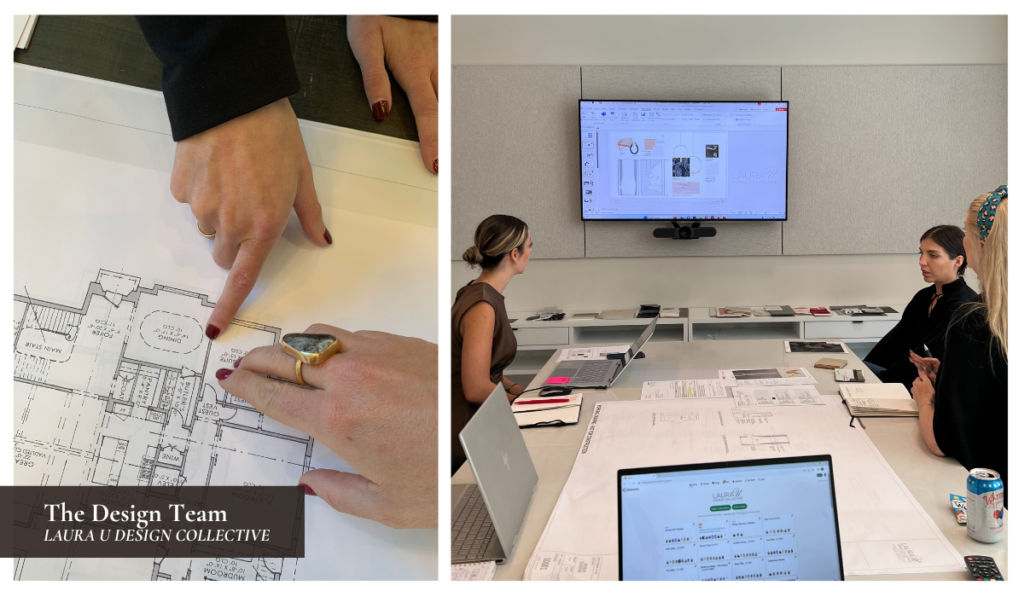
Melissa explains that Design Development often accounts for roughly half of the hours in a furnishings-focused project, as layouts, materials, and custom elements are refined in detail. In renovation projects, construction administration can represent a similarly large share of total time, sometimes reaching half of the project’s overall hours as designers coordinate continuously with builders and trades. Design Development is also when all of the presentations happen where we’re sharing with the client our thoughts and approach to the home. This is the FUN part for the client, so considering we want them to read these, I would make this part sound more involved and fun for them
Understanding where this time is spent helps explain why luxury interior design costs are more rooted in orchestration and collaboration than they are simply in decoration. Behind every finished space is a complex web, an extended process of planning, sourcing, coordination, and problem-solving that allows clients as much (or as little) involvement as they wish.
We use cookies to enhance your browsing experience, serve personalized ads or content, and analyze our traffic. By clicking “Accept”, you consent to our use of cookies.